

This guide groups the leading ai tools for freight forwarders by the job they perform. All vendor descriptions are based on their own published materials, checked in September 2026. The technology changes quickly, so you should always check the current product before you buy. This article also explains where FreighAI is not the right choice for your business. For a deeper look at the role of AI in freight forwarding, see our full guide, and for the wider shift, what a digital freight forwarder is.
How to choose: start with the job, not the tool
Choosing an AI tool for your freight forwarding operations should start with your biggest operational problem, not a vendor’s feature list. Most of these tools are designed to sit above your existing Transport Management System (TMS) or ERP, not replace it. Before you look at any software, ask four questions about your own business.
Four questions to ask your team first
- Where does the work arrive? Is it in email inboxes, a customer portal, an EDI feed, or an API?
- Which job eats the most hours? Is it preparing quotes, processing documents, preparing for customs, or chasing partners for updates?
- What is your system of record? Where does the final, authoritative data for a shipment live? Your TMS, ERP, or accounting software?
- Who approves what goes to the customer? What is your process for signing off on prices, delivery dates, and other commitments?
Once you know which job to fix, ask each vendor how its tool reads from and writes to your existing systems. You can see all FreighAI comparisons to understand how different tools connect.
Finally, ask every vendor on your shortlist to run a live test using one real week of your own emails or documents. A prepared demo does not show you how the tool handles your actual work.
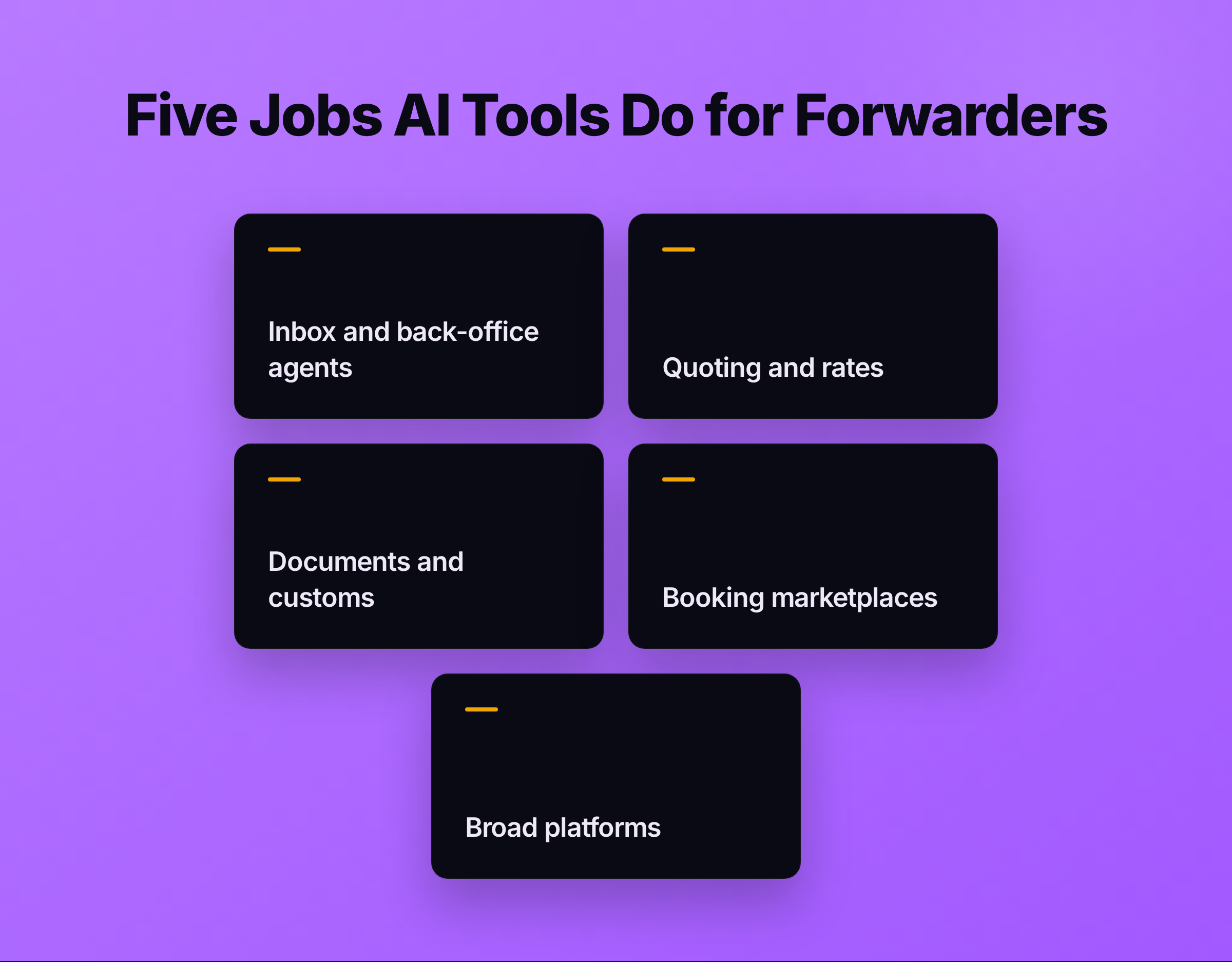
Inbox and back-office AI agents
This category of tools acts as an intelligent layer over your existing communication channels, especially email. They read what arrives, understand what the sender wants, and then either perform the work or route it to the right person on your team. Crucially, they are designed to keep a person in control of key decisions.
What this category does
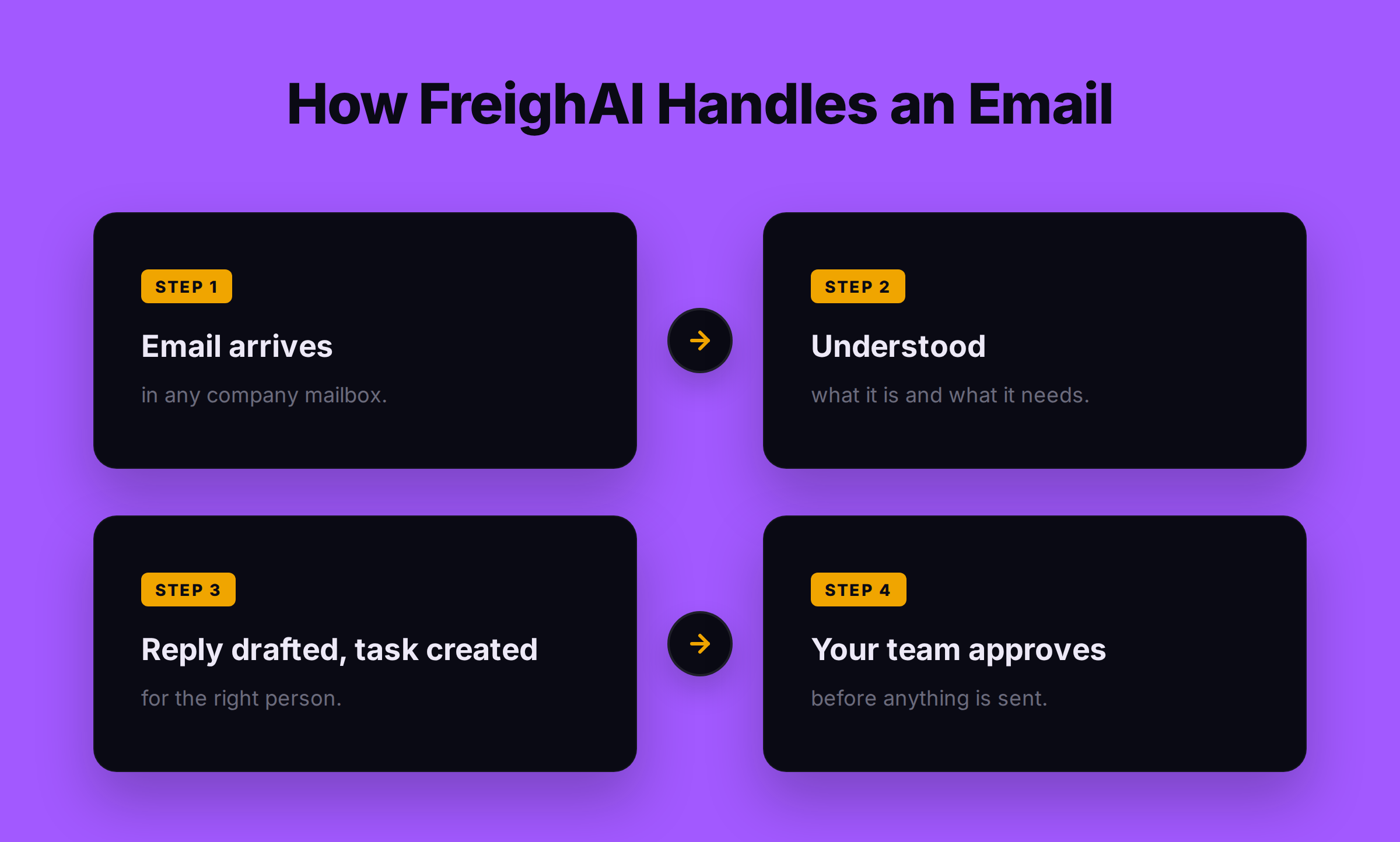
These freight AI agents connect to your inboxes and other channels. They read an incoming message, classify it (e.g., quote request, tracking update, invoice query), and extract key data. The agent then creates a task in the right system or drafts a reply, handing it off to a human for approval. They turn unstructured email traffic into structured work for your operations, pricing, and finance teams. If you are still deciding which work to hand over first, see what to automate first in the back office.
FreighAI
FreighAI is an AI-first freight operations platform that watches every company mailbox, from pricing and operations to tracking and accounts. It reads each conversation, understands the request, and turns it into a finished task for the right person, with the answer already drafted. Your team approves every reply before it sends, ensuring a human always has the final say on customer communication. It is built for mid-market forwarders of 40 to 200 people who don't have an in-house platform team. You can learn more about how FreighAI works with your existing systems, and see it in use in the Infinity Logistics customer story. A key principle is that you keep your TMS for the records; FreighAI runs the work around it.
5U AI
5U AI sells its product as a team of AI "workers," each with a specific job title like "Rate Manager" or "Track-and-Trace Worker." This allows you to start by automating a single, specific job within your operations and add other workers over time as you see results. See a direct comparison of FreighAI vs 5U AI.
Zauber
Zauber provides pre-configured agents for large sea and air forwarders, designed to run from the Outlook inbox. It has a deep connection to CargoWise One. On CargoWise file creation, arrival notices and terminal ETAs it goes deeper than anything FreighAI offers today, and it is built for top-tier forwarders rolling out across many country branches. Explore the differences in FreighAI vs Zauber.
Levity
Levity is a platform your own team builds AI workflows in. It uses a visual canvas, modules, and connectors, giving you the tools to design automation flows that match your specific processes. This is for teams who want to build and manage their own AI solutions. See how this approach compares in FreighAI vs Levity.
Nunar
Nunar offers agents that are designed to complete specific, named processes inside your existing ERP, finance, and customs systems. Its focus is on tasks like RFQ intake, customs declarations, trade-portal entries, reconciliation and purchase orders, with rules checked first and a person approving. You can read a full breakdown in our FreighAI vs Nunar comparison.
Augment
Augment provides a single agent that works across phone calls, email, text messages, and portals. Its published material focuses on the North American road freight market, serving brokerages, carriers, drayage companies, and 3PLs. For more details, see FreighAI vs Augment.
LSP44
LSP44 is the agent and API business that project44 launched in July 2026 for logistics service providers. It is aimed primarily at brokers and 3PLs, with its strongest features focused on carrier procurement, truckload dispatch, dock appointments and carrier onboarding. See the full comparison: FreighAI vs LSP44.
Quoting and rate management
If your sales or pricing desk spends most of its day buried in spreadsheets and carrier websites, a quoting and rate management tool may be your best starting point. These tools are built to solve a specific commercial problem: keeping supplier rates current, applying your margin, and quickly turning a customer enquiry into an accurate quote.
What this category does
These tools centralize your buy rates from carriers, agents, and rate sheets. When a quote request comes in, the system finds the applicable rates, adds your configured margin and local charges, and generates a professional quote for your team to review and send. For a wider view of quoting tools, see the freight quoting software landscape.
Wisor
Wisor describes its product as a commercial platform that manages the entire workflow from RFQ to revenue. It provides central rate management and a quoting tool that produces a draft for a person to review before it is sent to the customer. For a detailed look, see our FreighAI vs Wisor analysis.
Aircon
Aircon is a decision layer specifically for air freight quotes. It checks pricing, routing, operational feasibility, and margin rules together before a quote is generated. This helps ensure that the option you quote is not just cheap but also viable. Read the full comparison: FreighAI vs Aircon.
Freightify
Freightify is a rate platform that centralizes the procurement, management, and distribution of your freight rates. It includes a quoting module and a white-label customer portal that you can offer to your clients for self-service quoting. See how it stacks up in our FreighAI vs Freightify comparison.
Quotiss
Quotiss is a quoting and rate management tool built for the sales desk. It offers tariff templates by mode and has published pricing, making it a straightforward option for teams focused purely on accelerating their quoting process. Learn more in the FreighAI vs Quotiss breakdown.
cargo.one
cargo.one is a rate platform with direct integrations to airlines for live air booking. It also provides ocean rate management and quoting capabilities, combining rate visibility with the ability to execute bookings on the same platform. See the detailed comparison: FreighAI vs cargo.one.
Documents, customs, and accounts payable
This category of AI tools for freight forwarding focuses on the mountain of paperwork that accompanies every shipment. These tools use AI to read freight documents, extract and validate the data, and prepare entries or payables in your own systems, reducing manual data entry and errors.

What this category does
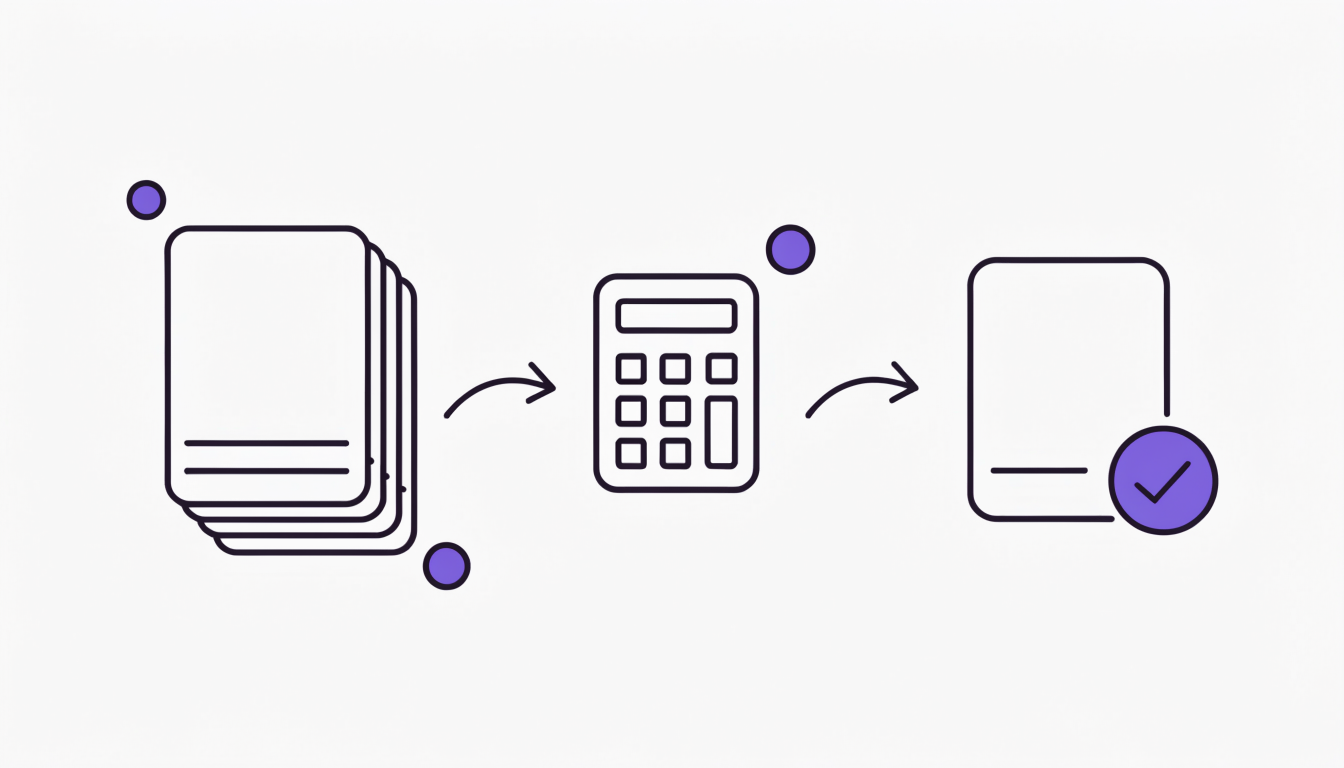
These tools ingest documents like commercial invoices, packing lists, and bills of lading. They extract key fields, check for inconsistencies, and then populate records in your TMS or accounting software. This automates the first, most repetitive step of customs preparation and vendor invoice reconciliation. Ask each vendor whether it files the entry itself or prepares it for your broker.
Raft
Raft offers configurable document extraction for customs brokerage and accounts payable. It can take in documents over email, API, EDI, and file drop, making it flexible for various partner communication styles. Its focus on customs and AP makes it a deep, specialized tool. See our full analysis: FreighAI vs Raft.
Reform
Reform provides AI agents for specific document and filing work. Its published materials detail workflows for customs entry preparation, Importer Security Filing (ISF), entry audits, and duty drawback. Read the detailed comparison: FreighAI vs Reform.
Freightmate AI
Freightmate AI is a focused document and data-entry product. It is designed to automate the creation of shipment records, prepare data for customs entries, and process accounts payable invoices, targeting the most common data-entry bottlenecks in a forwarding operation. For more details, see FreighAI vs Freightmate AI.
Booking marketplaces with AI
Booking marketplaces are digital platforms that connect you directly with carrier capacity. They use AI to help you find the best rates and schedules, book space, and in some cases, pay the carrier, all in one place. These are powerful procurement tools.
What this category does
These platforms aggregate capacity and pricing from multiple airlines or ocean carriers. You can search for options, compare rates, and execute a booking electronically. They are excellent tools for buying freight more efficiently, but they do not run the back-office operations that surround the booking, such as customer communication or final invoicing.
Freightos for Forwarders
Freightos for Forwarders is a platform for air cargo that includes rate and quote management, a sales portal for your customers, and direct booking with many airlines. It also lets you pay the airline directly. See our full comparison: FreighAI vs Freightos.
CargoAi
CargoAi is an air cargo marketplace that provides schedules, e-booking, tracking, and a payment rail to the airline. It is focused on providing broad connectivity to the air cargo ecosystem, allowing forwarders to find, book, track, and pay for capacity digitally. Read the detailed breakdown: FreighAI vs CargoAi.
Broad logistics platforms with AI inside
Some vendors offer broad, enterprise-level platforms that aim to be the single operating system for a logistics business. These systems have AI capabilities built into a larger suite that covers everything from transport and warehousing to procurement and finance.
What this category does
These platforms are designed to replace a patchwork of different systems (TMS, WMS, spreadsheets, etc.) with one integrated solution. They are a much bigger purchase than a single-purpose AI agent and are best suited for a business that is looking to overhaul its entire technology stack at once.
Shipsy
Shipsy is an enterprise platform that covers transport, warehousing, procurement, tracking, and invoice reconciliation. It includes a dedicated freight forwarder module and has named AI agents across the platform. See our full analysis: FreighAI vs Shipsy.
Fero
Fero is a transport and distribution platform that features a conversational assistant that works over voice, WhatsApp, and email. Its approach is to move work off traditional email by using in-platform messaging, centralizing communication around the transport job itself. Read the detailed comparison: FreighAI vs Fero.
Where FreighAI is not the right tool
Honesty is important. No single tool is the best AI for freight forwarding operations in every situation. FreighAI is built to be a comprehensive operating layer for a mid-market forwarder's daily work, but it is not the right choice for every problem.
Here is where you should look at other options first:
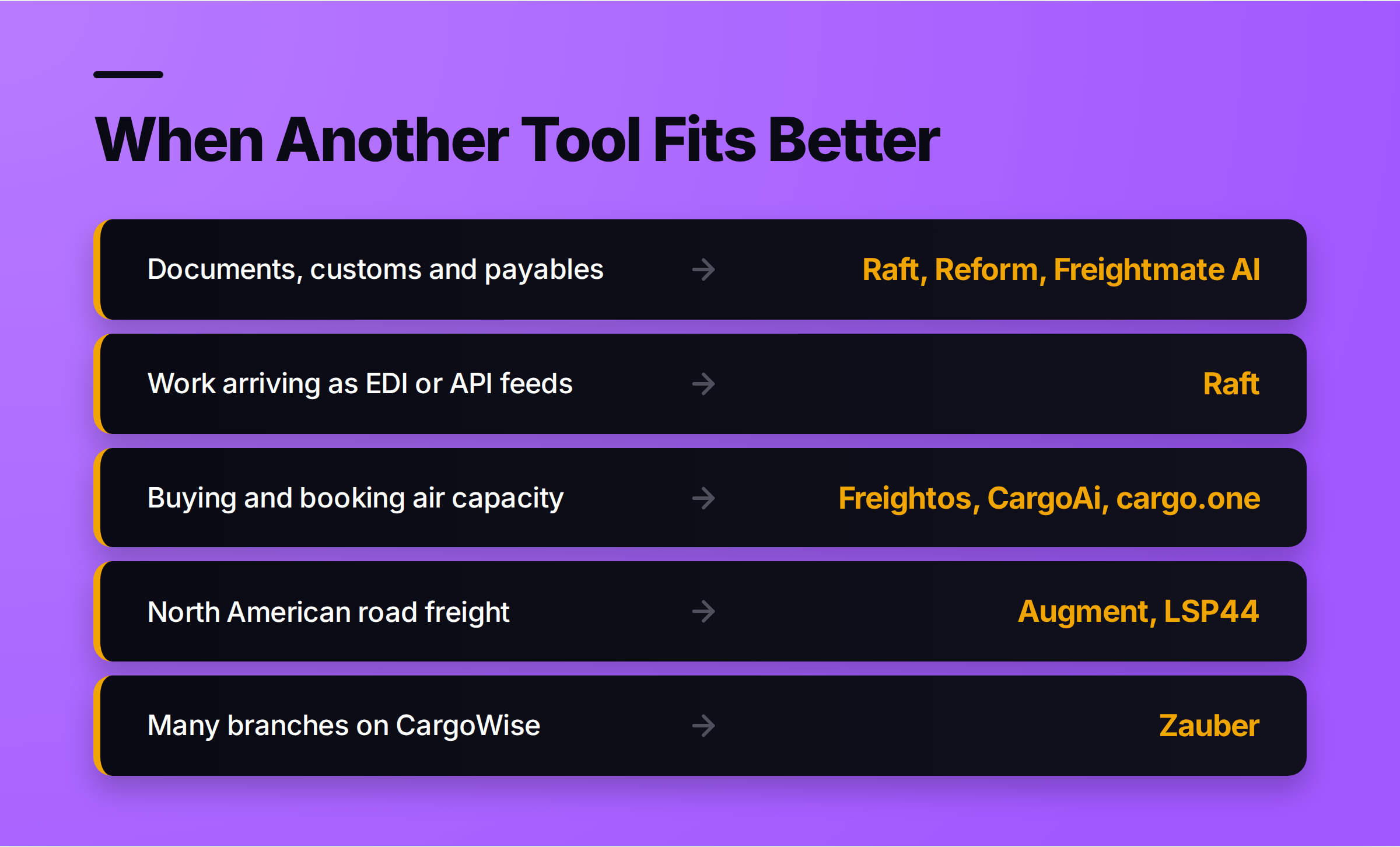
- If documents, customs, or payables are your entire problem. Specialized tools like Raft, Reform, or Freightmate AI go deeper on these specific workflows. They are built from the ground up for document-heavy processes.
- If much of your work arrives as EDI or API feeds. FreighAI is designed to read unstructured communication like email. It does not offer EDI or API intake channels today. Platforms like Raft are built to handle these structured data feeds.
- If you need to buy and book air capacity directly. A marketplace like Freightos, CargoAi, or cargo.one is the right tool. They provide direct access to airline inventory and booking. FreighAI runs the work around your existing carrier relationships; it does not provide a carrier network or payment rail.
- If you are a North American road broker or carrier. Tools like Augment and LSP44 are built specifically for the workflows of domestic truck brokerage, dispatch, and carrier procurement.
- If you are a top-tier global forwarder rolling out a solution across many branches on CargoWise. You should look at Zauber. It is designed for deep integration with CargoWise in large enterprise environments.
And with FreighAI, customs filing stays with your agent or broker, in the system they already use.
A one-week test for any AI tool
The only way to know if an AI tool will work for your business is to test it on your real work. A vendor's polished demo is not a real test. Here is a simple, effective process for evaluating any of the best AI tools for freight forwarders.
- Prepare your data. Take one real week of emails and documents from your team's workload. Do not clean it up or pre-sort it. This is your test set.
- Run a live test. Ask each shortlisted vendor to process your test set in a live session. Do not send it to them in advance. Watch how the tool handles your actual messages, attachments, and internal jargon.
- Check the outputs. For every task, ask: Who approves what goes to the customer? What, exactly, does it write back into your TMS? What happens when the AI is unsure or the data is incomplete?
This process will quickly show you which tools can handle the complexity of your business and which cannot. When you are ready, you can bring one week of your email and see how FreighAI handles your real work.
How this page was checked
Every vendor description above is paraphrased from that company's own published pages, checked in September 2026, and each links to a full FreighAI comparison with its sources. No vendor figures, customer names or prices are repeated. Products in this market change quickly, so check each vendor's current material before you buy.