
Your business is built on relationships, experience, and trust. But every day, your team spends hours on repetitive work: retyping details from emails, chasing carriers for status updates, and manually checking rates. The term ‘digital freight forwarder’ often brings to mind a venture-funded tech company. For you, the more useful question is different: how does your established business become digital without losing what makes it good?
The answer is not a new website or a complete system replacement. It is taking the repetitive work between the message and the answer off your people’s desks, one workflow at a time, while the customer relationship stays human.
This process of digital freight forwarding is an operating model change. It connects the steps from enquiry to invoice with structured data. Your people keep their relationships with customers and carriers. They keep their commercial judgment. The software handles the repetitive administrative tasks, freeing your team to solve problems and win business. This shift focuses on making your existing operations more efficient, not replacing them.
Two meanings of 'digital freight forwarder'
The term ‘digital freight forwarder’ has two common meanings. Understanding the difference helps you choose the right path for your business.
Meaning 1: The digital-native forwarder
This is a company built on its own software platform from day one. It typically offers customers a fully online experience: instant quotes, online booking, and a dashboard for tracking shipments and managing documents. These companies position themselves as technology businesses that provide freight services. Their model depends on attracting customers who prefer a self-service, transactional relationship.
Meaning 2: The established forwarder that digitises its work
This is a traditional forwarder, like yours, that has adopted freight forwarding technology to automate its internal workflows. Enquiries that arrive by email are read by software, which drafts a quote for a person to approve. Shipment documents are scanned and their data extracted automatically. Routine tracking requests get an automated reply. Carrier invoices are checked against the job file by the system. The work still happens, but the manual re-keying and chasing are done by software, with your team making the final decisions.
What does not change: The business is still freight forwarding
In both cases, the business is still a freight forwarder. FIATA describes the forwarder as the party that makes sure internationally traded goods arrive at the right place, at the right time, in good condition and at the most economical cost. This core role involves arranging carriage, working with transport providers, and managing information. Whether digital-native or digitised, a digital freight forwarder still holds relationships with carriers and agents and takes responsibility for the shipment. The difference is in how the work gets done.
What makes a forwarder digital
A forwarder becomes digital when its work runs on connected, reusable data, not on isolated emails and spreadsheets. It is about the operating model, not just the software you buy. Here are the key characteristics of a truly digital operation.
Data is entered once and reused
In a digital setup, a shipment has a single master record. Details like shipper, consignee, cargo dimensions, and Incoterms are entered once and then used to generate quotes, booking requests, bills of lading, and invoices. This reduces errors from retyping and ensures everyone works from the same information.
Quotes are produced from controlled rates
Instead of searching through spreadsheets and old emails, your team uses a central system with your own negotiated carrier rates. This quotation automation for freight forwarders keeps quotes fast and consistent. The system manages validity dates, surcharges, and margins, with an audit trail for every price offered.
Customers can see status without emailing
A key part of digital freight forwarding is providing proactive visibility. Instead of your team manually checking carrier websites, software automatically pulls in milestones. Customers can see their shipment’s status on a portal, reducing "where is my cargo?" emails and calls. This lets your operations team focus on managing exceptions, not providing routine updates.
Documents are read by software, not retyped
Software reads commercial invoices, packing lists, and carrier bills, extracting the data automatically. This removes a great deal of manual data entry and reduces errors. The system can validate the extracted information against the shipment record and flag discrepancies for a person to review.
A comparison: The traditional way vs. the digital way
The shift to a digital operating model changes daily tasks across your business.
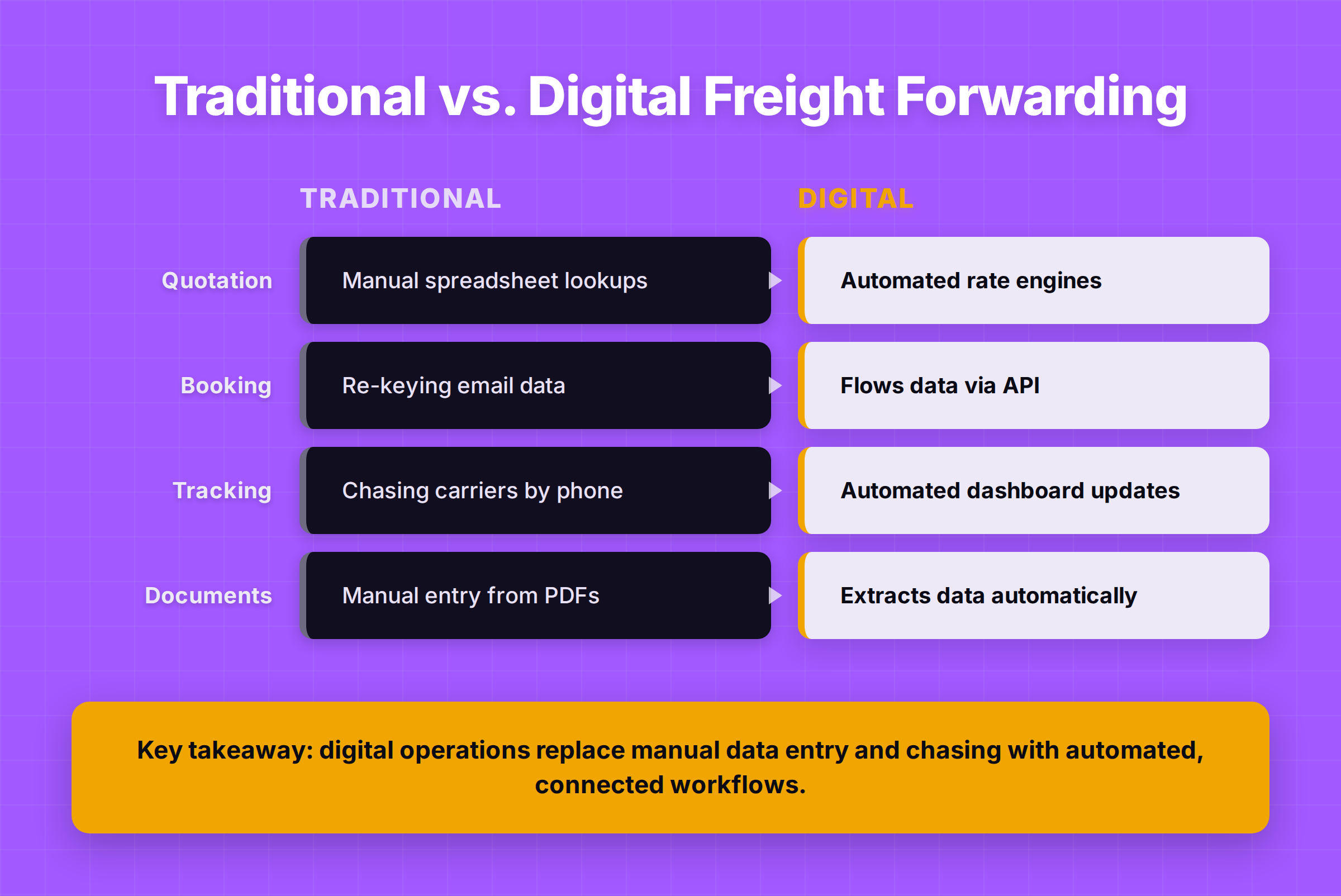
| Area | Traditional Way | Digital Way |
|---|---|---|
| Quotation | Email requests, manual rate lookups in spreadsheets | Structured request, automated rate engine, approval workflow |
| Booking | Data re-keyed from email into carrier systems | Accepted quote data flows into a booking request via API or portal |
| Documents | Manual data entry from PDFs and scans | Data extracted by software, populating templates automatically |
| Shipment Tracking | Staff chase carriers by email and phone for updates | Automated milestone updates feed a dashboard for staff and customers |
| Finance | Job files reconciled manually after shipment | Live job costing with automated accruals and invoice checks |
| Management View | Reports on past performance run from accounting data | Real-time view of open quotes, margins, and team workload |
Where traditional forwarders already have the advantage
Digital tools are powerful, but they do not replace the core advantages your established forwarding business has built over years. A successful digital transformation in logistics builds on these strengths, not over them.
Relationships with partners and customers
Your long-standing relationships with customers, carriers, and overseas agents are your most valuable asset. This trust determines whether you get space on a tight sailing, a quick answer on a customs issue, or flexibility during a disruption. Software can manage contacts, but it cannot build trust. These relationships are critical, especially when handling cargo through busy hubs like Jebel Ali, Nhava Sheva, or Los Angeles/Long Beach.
Deep knowledge of lanes and cargo
Your team possesses deep knowledge of specific trade lanes, commodities, and cargo types. They know which carriers are reliable for oversized cargo to Felixstowe or the best way to handle customs at Chennai. That expertise solves problems a generic online platform cannot.
Commercial and operational judgment
Software can present options, but it cannot exercise judgment. Your experienced staff decide whether a cheaper rate is worth the risk of a less reliable carrier, when to protect space for a key client, or how to manage a shipment that gets rolled. This human ability to weigh price, risk, and service is a competitive advantage that automation complements but does not replace.
The human connection customers want
Many shippers, especially those with complex or high-value freight, want a named person to call. They want an expert who understands their business and can take accountability when things go wrong. A digital workflow should take administrative work off that person’s plate, freeing them to provide better service, not replace them with a chatbot.

A practical path: digitise one workflow at a time
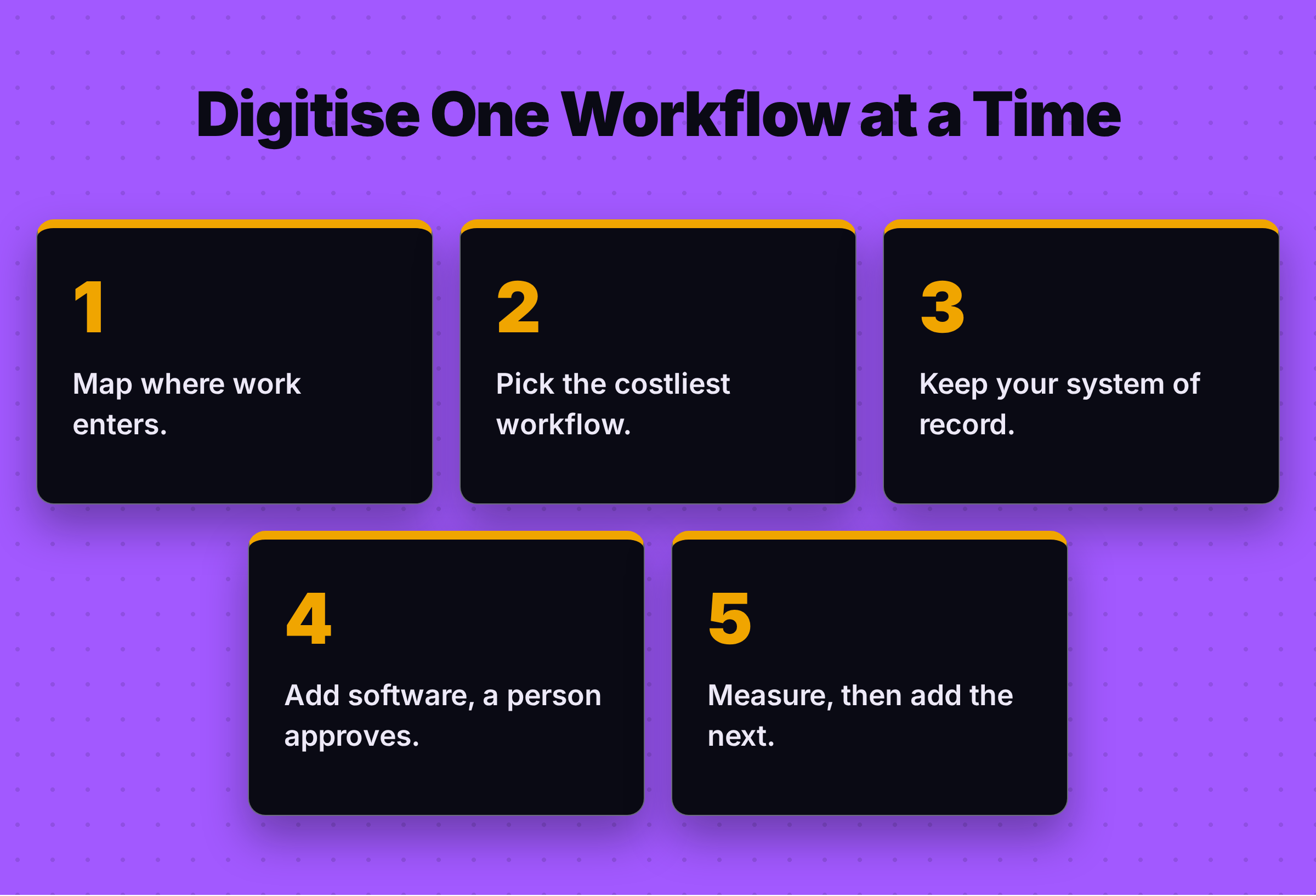
Becoming a digital freight forwarder is a journey, not a single event. The most successful approach is to digitise your business one workflow at a time, starting with the one that causes the most pain. This avoids the risk and expense of a "big bang" project.
Step 1: Map where work enters and gets retyped
Before you buy any software, understand your current process. For one week, track where work comes from (email, WhatsApp, phone) and every time data is copied from one place to another. Identify the biggest bottlenecks. Is it your pricing team trying to build quotes from ten different spreadsheets? Or your operations team answering the same tracking questions all day? This map will show you where to start.
Step 2: Pick the workflow that costs the most
Choose the workflow that consumes the most staff time or creates the most errors. For most forwarders, this is either the enquiry-to-quote process or handling "where is my cargo?" replies. By focusing on the highest-impact area first, you can deliver a clear win for your team and your customers. This is especially true for forwarders running on Excel and Tally, where manual work is most concentrated.
Step 3: Decide what stays the system of record
You likely already have a Transport Management System (TMS) or an accounting system that acts as your system of record. You do not need to replace it. The goal is to add a layer of automation around it. Your TMS can remain the single source of truth for shipment files, while new tools handle the work that happens in your inbox. This approach is central to understanding AI in freight forwarding.
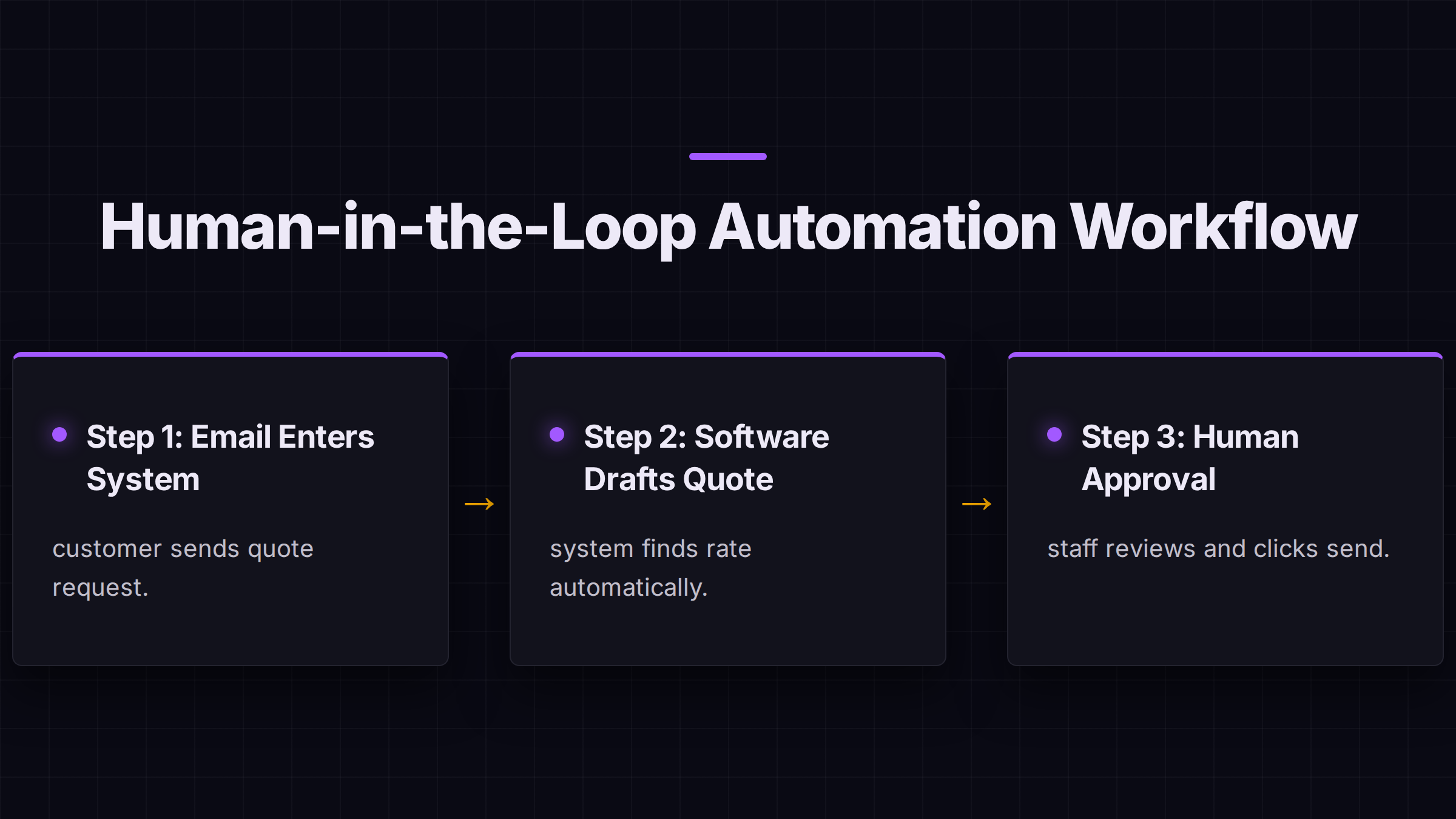
Step 4: Put software on that workflow with human approval
Implement a tool to automate the chosen workflow, but ensure a person approves every customer-facing communication. This is the "human-in-the-loop" model. For example, software can read an email, find the right rate, and draft a quote, but one of your team members must click "send." This gives you the speed of automation without risking customer trust. You can learn more about what agentic AI actually does in this process.
Step 5: Measure, then add the next workflow
After implementing the first change, measure the impact. Did quote turnaround time decrease? Did "where is my cargo?" emails go down? Use these results to build momentum and decide which workflow to tackle next. This could be agent chasing, document management, or carrier invoice reconciliation. See what to automate first in the back office. For more on choosing tools, see the freight forwarding software guide.
Digital transformation mistakes to avoid
The path to becoming a digital freight forwarder has common pitfalls. Avoiding them can save you significant time, money, and frustration.
Replacing your TMS first when the pain is in the inbox
Many forwarders assume digital transformation in freight forwarding starts with replacing their TMS. But if your biggest problem is the chaos of managing hundreds of daily emails, a new TMS will not solve it. Your team will just end up manually copying the same data from their inbox into a new system. Fix the intake process first.
Buying a customer portal nobody uses
A shiny customer portal is useless if your customers prefer to send you emails. Before investing in a portal, understand how your customers want to communicate. Often, a better first step is to automate the processing of their emails, so you can respond faster and more accurately through the channel they already use.
Automating without an approval step
Full automation without human oversight is risky. One wrong automated quote or incorrect status update can damage a customer relationship you have spent years building. Always keep a person in the loop for critical, customer-facing communications.
Trying to digitise everything at once
Attempting to overhaul your entire operation simultaneously is a recipe for failure. It creates too much change for your team to absorb and too much risk for the business. Start with one workflow, prove the value, and build from there. A phased approach is more manageable and delivers results faster.
Where FreighAI fits
FreighAI is designed for established, mid-market forwarders who want to digitise without replacing what works. It is not another TMS; it is a freight forwarder operations platform that runs the work around your existing systems. To compare the wider market, see the best AI tools for freight forwarders.
An automation layer for your daily work
Our value proposition is simple: every email your company receives is read, understood, and turned into a task for the right person, with the answer already drafted. Your team just has to approve it. FreighAI pulls your rate cards, checks the carrier, looks up the customer's history, and reads the latest shipment status. It does the background work so your people can make faster, better decisions.
Keep your TMS for the records
We believe you should keep your TMS for the records. FreighAI runs the work around them. Our platform integrates with your existing TMS or accounting system, acting as an intelligent automation layer that handles the high volume of unstructured communication that lives in your inbox. This lets you get the benefits of automation without a disruptive and expensive system replacement. You can learn more about how FreighAI works on our site.
Built for forwarders without a platform team
FreighAI is built for mid-market forwarders of 40 to 200 people who do not have an in-house team to build a custom platform. We provide the power of a sophisticated digital freight forwarding platform in a way that is practical and accessible for your business. You can start with one workflow and see the impact on your own work.