
This comparison of the best freight forwarding software is designed to give you a clear, honest starting point. FreighAI is not a TMS and is not on this list. It runs the work around the system of record you decide to keep.
What a TMS does for a freight forwarder
A forwarder’s Transportation Management System (TMS) or forwarding ERP is the system of record. It is where you manage jobs, bookings, house and master documents, costs, invoices, and accounts. For many, it also handles customs data. This is different from a shipper’s or carrier’s TMS, which focuses on planning and executing their own transport.
The forwarder’s system must connect the commercial, operational, and financial parts of every shipment. It holds the single source of truth for a job, from the initial quote to the final profit calculation. For a full breakdown, see our guides on transportation management systems for freight forwarders and the freight forwarding software guide.
How to choose: five questions
Before you look at any software, answer five questions about your business. The answers will give you a clear set of requirements to test each vendor against. This is the most reliable way to find the best TMS software for your specific needs.
1. What modes do you run?
List the services you actually sell: air, ocean, road, customs, and warehousing. An air-heavy business needs strong support for e-AWB and airline messaging. An ocean forwarder needs robust container and consolidation management. Do not assume a system is equally strong in all modes.
2. What is your size and structure?
A single office has simpler needs than a business with several branches or legal entities. If you have multiple branches, you need a system that can handle inter-branch jobs, separate profitability, and consolidated reporting without forcing you to duplicate customer or rate data.
3. Which markets do you serve?
Local rules matter. If you operate in the UAE, check how the system will handle the country's electronic invoicing programme, which the Ministry of Finance is phasing in. A UK forwarder needs a system that handles post-Brexit customs processes, and an Indian forwarder needs GST and TDS handled properly. Your choice must fit the compliance needs of every market you operate in.
4. What is the system's scope?
Decide if you want one system for everything (operations, finance, CRM, customs) or a lighter operational system that integrates with other tools like your existing accounting software. An all-in-one platform promises a single source of truth but can be complex to implement. A best-of-breed approach gives you flexibility but requires managing integrations.
5. How do you buy and implement?
Check if prices are published or if you need a custom quote. Ask what the price includes. Data migration, training, and integrations can be significant extra costs. Understand the implementation process and what resources you will need from your own team.
The twelve systems at a glance
This table summarizes the twelve freight forwarding systems described in this article. The information is taken from each vendor's own website, as checked on 30 September 2026. It is a description, not a ranking. Use it to build your initial shortlist.
| System | What it is | Modes | Built for (as stated) | Prices published |
|---|---|---|---|---|
| CargoWise | One platform for forwarding, customs, warehousing and transport, quote to invoice | Air, ocean, road and rail, customs, warehouse | Forwarders, customs brokers, warehouse operators; global | No |
| Descartes Forwarder TMS | SaaS TMS for forwarders within a wider broker and forwarder suite | Air, ocean, road, customs, warehousing | Forwarders, NVOCCs, customs brokers | No |
| Magaya | Modular platform: forwarding, customs compliance, warehouse, extensions | Ocean, air, ground, customs, warehouse | Forwarders, customs brokers, 3PLs, NVOCCs | No |
| Shipsy | Broad AI-native logistics platform with a forwarder solution | Ocean, air, road, multimodal | Enterprise logistics operations | No |
| GoFreight | Cloud forwarding software: rates and quoting, operations, billing, customs | Ocean, air, customs | Forwarders; US, Mexico and Asian markets named | No |
| Logitude | Cloud forwarding system with CRM, portal and invoicing | Air, sea, customs | Fast-growing and small and mid-sized forwarders | Yes |
| ShipThis | Forwarding ERP: operations, accounting, CRM, quoting | Sea, air, road, rail, customs, warehouse | Forwarders, NVOCCs, customs brokers, 3PLs | Yes |
| Scope (Riege) | Integrated freight management for air, ocean and customs | Air, ocean, customs | Forwarders | No |
| Logi-Sys | All-in-one cloud ERP on one database | Land, sea, air, customs, warehouse | Forwarders, consolidators, customs brokers | No |
| NewageNXT | Cloud ERP for forwarders and 3PLs | Ocean, air, land, domestic, parcel, customs | Small teams to enterprise; Americas, MEA, APAC | No |
| Fresa | Family of freight management products (Global for large multi-entity forwarders, Gold for group companies) | Air, sea, land, warehouse | Forwarders and group companies | No |
| Kale CORVI | Forwarding management system: booking, documentation, billing, coordination | Not stated | Forwarders | No |
Caption: from each vendor's own website, checked 30 September 2026.
Global and enterprise platforms
These platforms are designed for forwarders who need a broad, often global, system to manage complex operations across multiple functions. They are typically a fit for larger or more geographically diverse businesses.
CargoWise
CargoWise presents itself as a single, integrated platform that covers forwarding, customs compliance, warehousing, transport, and eCommerce. It is designed to manage the entire shipment lifecycle from the initial quote to the final invoice. It includes a customer portal, CargoWise Neo. You can see how FreighAI works by working alongside CargoWise.
Descartes Forwarder TMS
Descartes offers a SaaS-based TMS as part of its wider suite for brokers and forwarders. It is designed to manage shipment operations, customs compliance, accounting, and billing. The platform also includes features for pricing, multimodal shipment tracking, and a customer-facing shipment portal. It is positioned as a comprehensive solution for forwarders, NVOCCs, and customs brokers.
Magaya
Magaya is a modular digital freight platform. You can choose components for forwarding, customs compliance (it names the USA and New Zealand), and warehousing. It also offers extensions for rate management, a customer portal, CRM, and quote automation. See how FreighAI works by working alongside Magaya.

Shipsy
Shipsy describes itself as a broad, AI-native logistics platform built for enterprise logistics operations. Its offering includes solutions for transport, warehousing, and last-mile delivery. For forwarders, it provides a solution for managing quotes, bookings, documents, and tracking. Its focus is on orchestrating logistics across different functions, making it a potential choice for larger, diversified logistics groups. See FreighAI and Shipsy compared.
All-in-one cloud systems for small and mid-sized forwarders
These systems aim to provide a complete operational and financial solution in a single cloud-based package. They are often a good fit for small and mid-sized forwarders who want to replace spreadsheets and disconnected tools with one integrated system. For the options open to a team of ten to fifty people, see freight forwarding software for small businesses.
Logitude
Logitude is a cloud forwarding system that it says is designed for fast-growing and small to mid-sized forwarders. It includes operations, CRM, container tracking, a customer portal, and invoicing. Logitude is one of two systems on this list that publish its per-user subscription prices on its website, offering a clear view of potential costs.
ShipThis
ShipThis describes itself as an AI-native forwarding ERP that runs operations, accounting, CRM, quoting, and customer engagement in one system. It covers sea, air, road, and rail freight. Like Logitude, ShipThis also publishes a per-user price on its site.
GoFreight
GoFreight is a cloud-based, AI-powered forwarding software. It covers rate and quote management, operations, customs, billing, and accounting, and includes a customer portal. It covers ocean and air freight, and its FAQ names the US, Mexico and several Asian markets. It does not publish standard prices, requiring you to contact them for a quote.
Scope from Riege
Scope is an integrated freight management software focused on air freight, ocean freight, and customs. The platform includes functionality for quotations, invoicing, and a booking portal. It is positioned as a solution for forwarders who need strong, integrated management of their core air and sea operations and compliance workflows.
Systems with strong regional coverage
Some of the top freight forwarder software options are built with a deep focus on specific regions. These systems often have strong local compliance, tax, and customs features that are critical for operating in those markets.
Logi-Sys
Logi-Sys is an all-in-one cloud ERP built on a single database. It covers forwarding, customs, warehousing, transport, billing, accounting, and CRM. The company specifically names customs compliance support for India and the USA, making it a strong candidate for forwarders with significant operations in those countries. You can learn more about working alongside Logi-Sys.
NewageNXT
NewageNXT is a cloud ERP for forwarders and 3PLs that covers sales, operations, finance, and documentation. It highlights specific country solutions for markets including India, the UAE, Saudi Arabia, the USA, and Canada. This makes it a relevant choice for forwarders operating across those markets.
Fresa
Fresa offers a family of freight management products. Fresa Global is aimed at large, multi-entity forwarders, while Fresa Gold is designed for group companies. Its products are built to integrate forwarding operations with documentation and accounting.
Kale CORVI
Kale CORVI is the forwarding management system from Kale Logistics, a company best known for its cargo community systems. CORVI focuses on booking, documentation, billing, and operational coordination. Its product page names little beyond those four areas, so ask for a detailed walkthrough.
Where FreighAI fits: beside the TMS, not instead of it
FreighAI is not a TMS. It does not replace your system of record. You keep your TMS for the jobs, documents, and accounts. FreighAI runs the work around them.
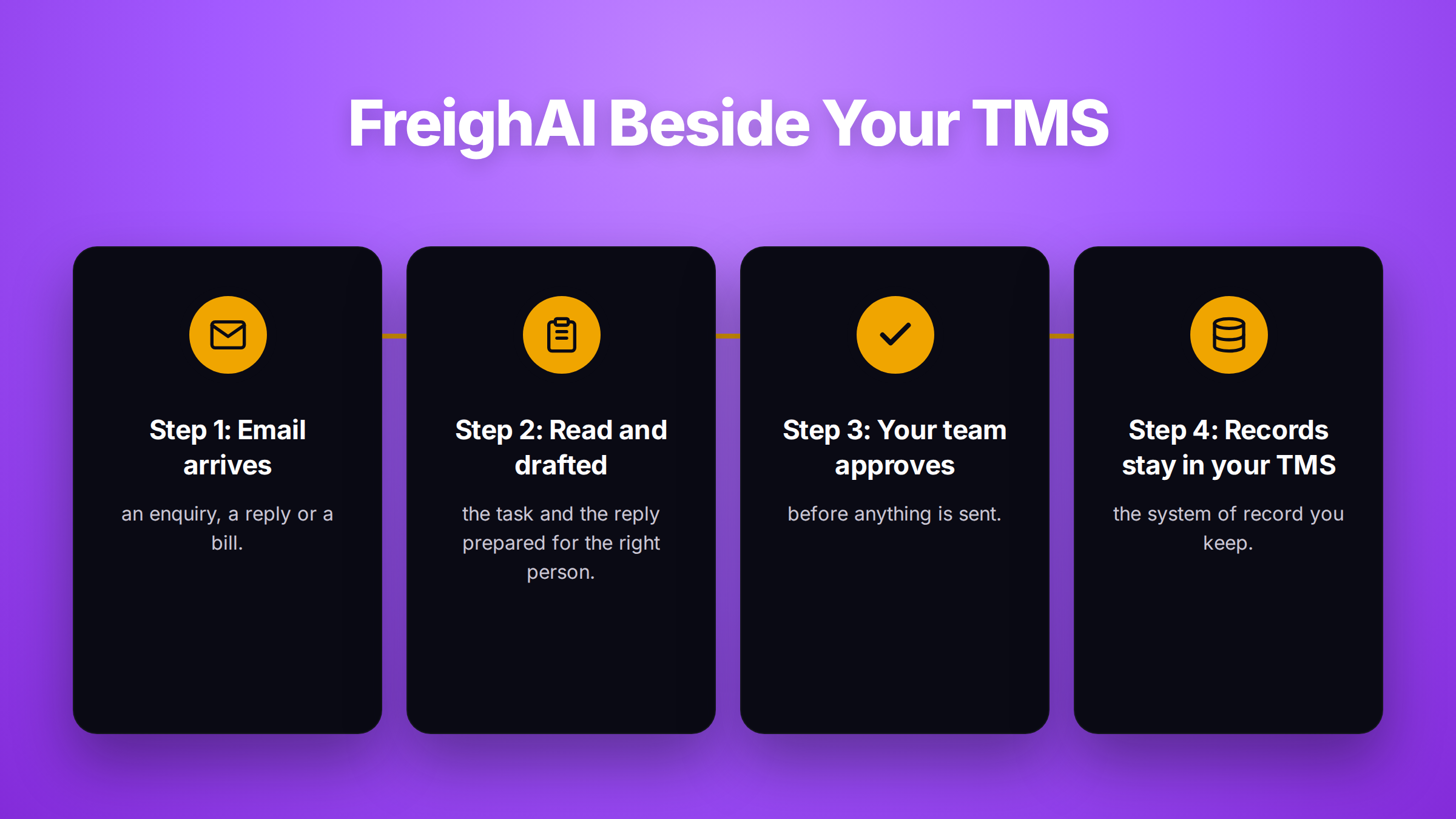
This is the key difference. The best TMS software structures your data, but much of your team's day is spent in the inbox, reading requests, finding rates, and chasing partners. FreighAI automates that work. Every email your company receives is read, understood, and turned into a task for the right person, with the answer already drafted. Your team just has to approve it.
This approach means you can gain the benefits of AI without a disruptive replacement project. It works by keeping your existing TMS. FreighAI has production-tested bridges with CargoWise, Logi-Sys, Kale CORVI, Shipsy, and Magaya. For example, CargoWise stays the system of record while FreighAI runs the work around it. You can see every system FreighAI connects to and how it can streamline your operations. See how FreighAI works and the Infinity Logistics customer story.
If you're looking for the best freight management software, choose the system of record that fits your business. Then, add an AI layer to run the work around it. To see how this works with your current setup, you can see it beside your own TMS.